

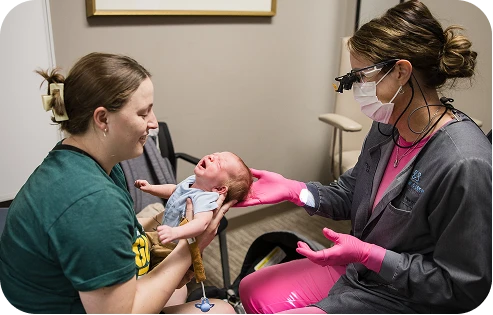
At Spring Valley Dentistry in Spring Valley, WI, a myofunctional evaluation looks at how the tongue and lips move and function—not simply whether a tie is visible. Dr. Skow and Missy want to understand what brought you in, what you hope to improve, and any previous care.
Tell us about feeding or swallowing difficulties, speech concerns, oral resting habits, jaw or neck tension, and sleep or breathing concerns. These symptoms can have different causes; an examination helps determine which findings need attention and whether another provider should be involved.
Prepare for your visit: complete the intake forms provided by our team, write down your main concerns and goals, and bring relevant reports or details of previous therapy. For a child, note what you observe during meals and sleep. You do not need to diagnose the cause before asking for an evaluation.
We look at where the tongue rests, whether the lips close comfortably, and how posture differs from movement during swallowing. These findings are considered with symptoms and breathing comfort; they do not establish a diagnosis on their own.

A tongue-tie release changes mobility; it does not automatically teach a new resting or swallowing pattern. Myofunctional therapy works on oral resting habits, tongue placement, comfortable lip closure, and swallowing coordination when the evaluation shows that this is appropriate.
Dr. Skow compares an individualized plan to physical therapy: people can have different strengths, limitations, and goals even when their concerns sound similar. Missy selects exercises for your findings, explains their purpose, and adjusts the plan as your coordination and comfort change. We do not recommend a universal online exercise routine.
Some patients may be offered therapy before or after a procedure; others may need therapy, monitoring, or another evaluation without a release. The order and follow-up depend on the individual—not a fixed treatment package. Breathing obstruction needs appropriate medical assessment before working on a breathing habit.
Read about tongue thrust and resting posture and how myofunctional therapy differs from speech therapy. A speech-language pathologist addresses indicated speech and language concerns; providers coordinate according to their qualifications.
Not every tongue-tie needs a release. A frenectomy releases restrictive tissue beneath the tongue or lip. Seeing a tie does not tell us whether that procedure will help. We consider symptoms, movement, medical history, age, previous support, and your goals before discussing the options.
Recommendations may include therapy, monitoring, further assessment, or a procedure when a functional restriction is relevant and the expected benefits justify the risks. For infant feeding concerns, lactation and pediatric assessment help identify other causes and whether feeding support is sufficient.
If a release is recommended, we explain its purpose, alternatives, comfort measures, and individualized aftercare and follow-up. We do not promise that a release will resolve sleep, speech, or growth concerns. If it is not recommended, we explain what to monitor and whether another provider can help.
For related guidance, explore mouth-open sleeping in children or our airway screening and referral approach. Adults should contact the team to confirm the appropriate evaluation and current treatment or referral pathway.
Watch Dr. Skow explain whether every tongue-tie needs a release.



Thank you for reaching out. A member of our team will get back to you shortly!
In the meantime, feel free to give us a call if your question can't wait.
Call 715-778-5543